On this page
Your child drops a tower of blocks and screams as if the world has ended. Two minutes later they are laughing. Every parent of a small child knows how fast feelings move. It is tiring, and it is normal.
Emotional intelligence is the skill that carries a child from that scream to that laugh. At first they need your help. Later they do it alone. It is one of the most useful things a family and a preschool can teach together.
What emotional intelligence means for a young child
The phrase sounds grown-up. For a young child it means four small abilities:
- Noticing a feeling: "My tummy feels tight."
- Naming it: "I am nervous."
- Handling it: taking a breath, asking for a hug, walking away for a minute.
- Noticing how others feel: "Maya is sad. She dropped her cup."
None of these come by themselves. Children learn them from adults who show them, name them and stay calm while the child practises. That is why this belongs in a preschool's daily timetable and not only in a book.
Why it matters before reading and writing
A child who cannot handle a big feeling cannot easily listen to a story, wait for a turn or try a hard puzzle. The learning part of the brain is hard to reach when a child is upset.
The Harvard Center on the Developing Child studies how young children build their brains. It says they grow through back-and-forth exchanges with caring adults, which it calls "serve and return." A child babbles, points or cries. An adult answers. Those small exchanges lay the base for talking, paying attention and controlling feelings.
In plain words: warm adults who respond help children learn to calm themselves. Calm makes room for learning. A child who can say "I am cross, I need a minute" has more energy left for letters, numbers and friends.
What it looks like in a Preschool or KG classroom
You will not see a lesson called Emotional Intelligence. You will see it in ordinary moments.
At drop-off
A teacher kneels and says hello. A child is clinging to a parent's leg. "It is hard to say goodbye. I will stay with you for a minute." Then the teacher gives a job: help me water the plant. The feeling is named and accepted, and the child has a way forward.
During play
Two children want the same truck. The teacher does not grab it or demand sharing. She says, "You both want the truck. What can we do?" The children make a plan. Maybe a turn each. Maybe a second truck. They learned to negotiate without a speech.
In group time
Stories and songs about feelings let children talk about them from a safe distance. "How do you think the bear felt?" is easier to answer than "How do you feel?"
After a mistake
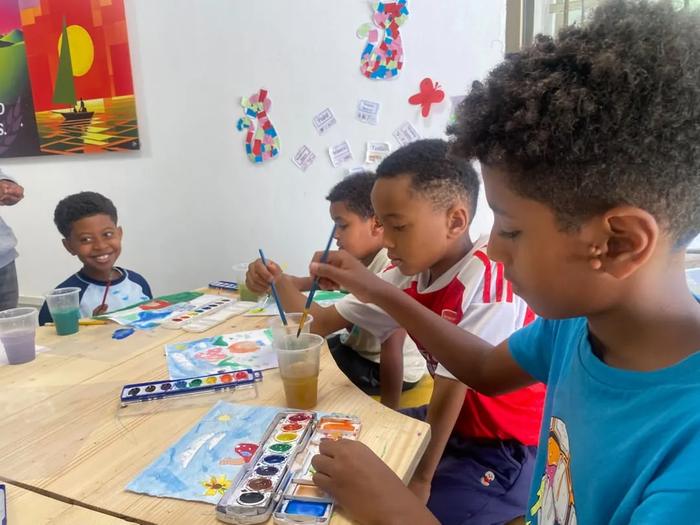
A child spills paint. A good teacher says, "Oh, that happens. Let's get a cloth together." Mistakes become normal. That is a gift to a child who might otherwise hide or lie.
Seven ways to build emotional intelligence at home
You do not need special materials. You need a few habits.
1. Name the feeling, not the behaviour
"You are angry that we have to leave the park" works better than "Stop being naughty." A child who hears the right word starts to borrow it. Keep your list short: happy, sad, angry, scared, excited, tired, worried.
2. Accept the feeling, limit the action
Say, "You are allowed to feel angry. You are not allowed to hit." The feeling is fine. The hitting is not. This is the heart of the skill, and it takes many tries.
3. Stay close while the storm passes
A child in a tantrum cannot hear a lecture. Stay near, speak softly and say little. Talk later, when your child is calm and can listen.
4. Let your child see you handle feelings
Children copy you. Try saying, "I am frustrated because the traffic is bad. I am going to take three slow breaths." Now they have a method. You do not have to be calm all the time. You do need to repair: "I shouted earlier. I am sorry. I was tired."
5. Read stories and ask about feelings
Picture books are great practice. Pause on a page and ask, "How is she feeling? How do you know?" Look at faces together. Children who read faces well tend to be kinder friends.
6. Give real choices
A child who is always told what to do never practises deciding. Offer choices inside limits: "Do you want the blue cup or the green cup?" Small choices build confidence, and confidence makes big feelings easier to carry.
7. Make a calm-down place
A cushion in a corner works. Add a soft toy and a book. Call it a place to rest, never a punishment. Say, "Let's go to the calm corner."
Worries parents often share
"My child cries every morning at school."
Tears at drop-off are common. They often stop within minutes after the parent leaves. A short, warm, same-every-day goodbye helps more than a long one. Tell the teacher how the morning went so they can follow up. If it lasts for weeks, ask the school what might help.
"My child is very shy."
Shyness is a temperament. It is not a flaw. Do not push. Give your child time to watch before joining in, and practise small steps at home, like saying hello to a neighbour. A good teacher makes space for a quiet child and notices when they are ready.
"My child hits when upset."
Hitting usually means big feelings and too few words. Stay calm, stop the hit and name the feeling. Then show what to do instead: "Stomp your feet. Squeeze this ball. Tell me you are angry." Expect to repeat this many times.
Feelings and culture
Families in Addis Ababa raise children with different ideas about showing feelings, and those ideas deserve respect. Many families teach respect for elders and calm behaviour in public. That fits well with emotional intelligence, because respect starts with noticing how another person feels.
What we ask is that adults, at home and at school, answer a child's feelings with interest and not shame. A child who hears "boys do not cry" learns to hide feelings. A child who hears "I can see you are sad, I am here" learns that feelings pass.
How we teach feelings at Nucleus
Feelings is one of six growth areas in our curriculum, next to thinking, body, values, tools and community. We follow the international Cambridge curriculum for the early years, and personal and social growth is a core part of it. Our sister school explains the thinking in its post on the best age to start school.
Our teachers are professionally trained and multilingual, so children can name feelings in the language that comes most naturally. Classes are small, so a teacher can spot a quiet child, an anxious child or a child who needs more movement. We work with parents through workshops and regular talks, because feelings are learned at home first.
Want to see it? Watch a morning at drop-off. It tells you a lot. You can register now when you are ready.
Related reading: Our curriculum · Admissions
Common questions
What is emotional intelligence in early childhood?
It is a child's growing ability to notice, name and handle their own feelings, and to notice how others feel. In young children it shows up as using feeling words, calming down with help and caring about friends.
When should I worry about my child's tantrums?
Tantrums are common in the early years. Talk with your child's teacher or a doctor if they are very frequent, last a long time, hurt your child or others, or get worse over several weeks.
Can emotional intelligence really be taught?
Yes. Children learn it by living with calm, responsive adults. These adults name feelings, set limits kindly and show good ways to handle their own emotions. It grows slowly, like reading.
How does Nucleus support children who find feelings hard?
Small classes let teachers notice early. We talk with parents, agree a plan and use the same words at school and at home. Children of all abilities are welcome to register, and we talk about each child's needs with the family, case by case.