On this page
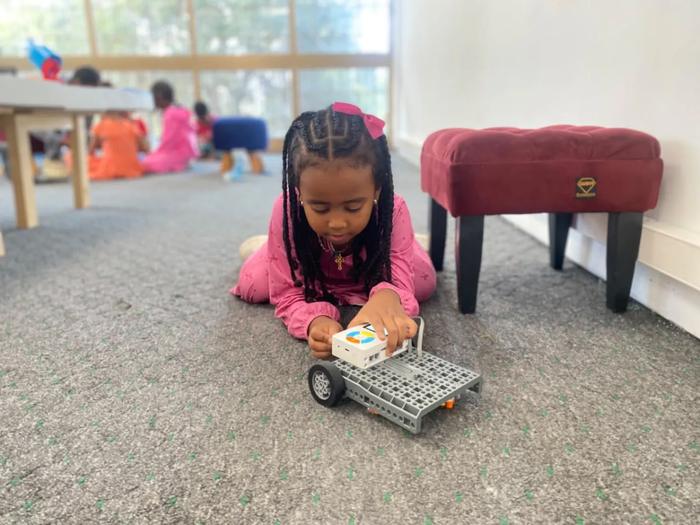
A small girl lies on the carpet. A little robot car sits in front of her. She nudges it, watches it roll, and tries again.
That is STEM for a preschooler. No lab coat, no formula. She is trying an idea and seeing what happens. STEM stands for science, technology, engineering and maths. At this age the four blur into one thing: curious hands and a patient adult.
What STEM means for a 3 or 4 year old
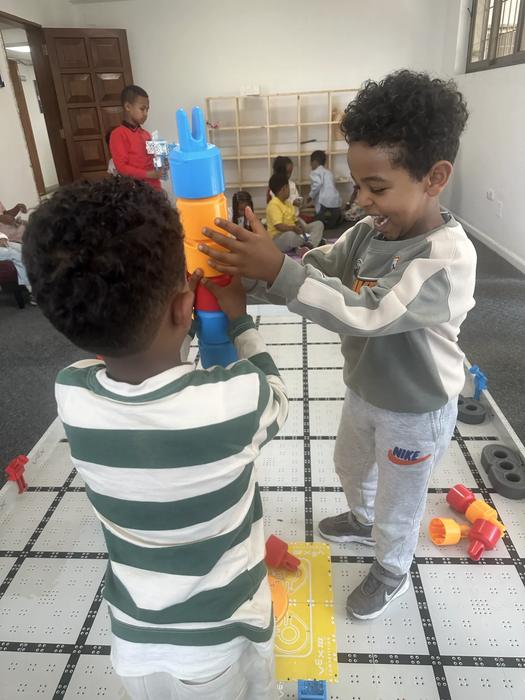
Ask a four-year-old why a block tower fell and you will hear a theory. "It was too tall." "The big block was on top." That is science. Ask her to build it again, and she will change the plan. That is engineering.
A good preschool does not teach STEM as a separate lesson. It builds it into the day. These are the habits we want children to practise:
- Ask a question: why did the water go down?
- Try something: pour it through a funnel.
- Watch what happens, and say it out loud.
- Change the plan and try again.
A first attempt that fails isn't a mistake. It's information. A child who learns that at 4 will be braver at 14.
Four parts of STEM, as a preschooler lives them
Science: touch, mix, plant, ask why
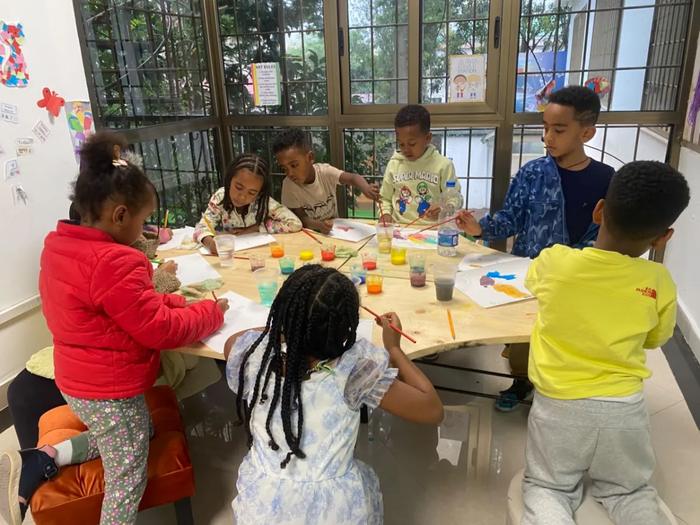
Science at this age is hands in the mix. Children feel sand when it is dry and again when it is wet. They plant a seed and check it each day. Two paints touch, and the colours blend. In our Preschool, science means touching, mixing and planting, and always asking why.
Technology: a tool, used with a teacher
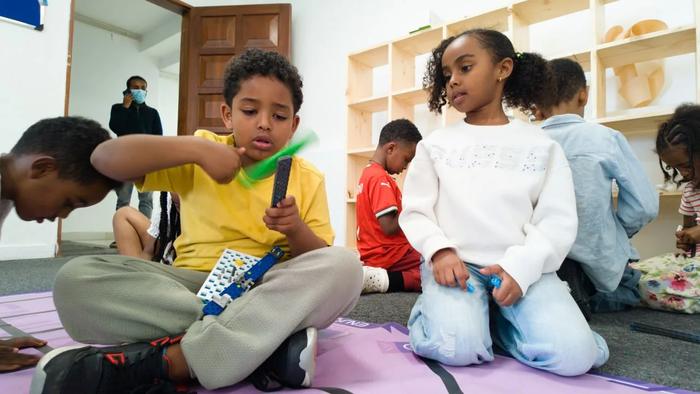
Technology does not mean a tablet. It can be a magnifying glass or a balance scale. It can also be a small robot car that follows a button. Children meet a little technology, always with a teacher beside them. Most of the day still belongs to blocks, sand and paint.
Engineering: build it, break it, build it better
Blocks, boxes and tape make an engineering lab. A child who builds a bridge for a toy car learns that wide legs hold more than thin ones. Nobody told her. She found out.
Maths: counting real things
Maths in preschool is counting steps and sorting shapes. It means saying more, fewer, before and after. It happens with snacks and sand, not with worksheets.
Why start so early
The international Cambridge curriculum, which our Preschool follows through Cambridge Early Years, asks children to understand the world and solve problems. Remembering facts is only part of it. STEM play is a natural place to practise both. A child who has tested three block towers and can say why the second one fell is doing exactly that.
There is a second reason in Ethiopia. Ethiopia's own education plans call for STEM in primary school, and the need is recognised even where delivery is uneven. Starting at 3 with simple, hands-on tasks gives children a head start in thinking, whatever they later choose to study.
What the evidence does and does not show
We want to be honest. We do not know of strong research that a robotics club raises exam scores in young children, and we will not promise it. Research on play-based learning finds a moderate positive effect, but rates the evidence as very limited.
So here is what we stand behind. STEM play gives children a real task for the thinking they will need. It lets children who dislike pencil work show what they understand. And it makes learning feel like something a child does, not something done to them. Our main school has written about this for older children too: see why robotics, STEM and agriculture matter in a child's early years.
A short day at a STEM-minded preschool
Picture the morning. Children arrive and settle. Then they gather for circle time with a story. Then they split into small groups. One group pours water between cups and guesses which will hold more. Another builds a ramp from blocks. A third plants seeds.
The teacher moves between them with questions, not answers. "What will happen if the ramp is steeper?" Then she waits. Waiting is the hardest part of her job. It's also where the thinking happens.
Eight easy STEM ideas for home
You do not need a kit. Try these on a quiet afternoon:
- Sink or float: drop a spoon and a leaf in a bowl of water. Guess first.
- Kitchen measuring: fill a cup and a jar. Which holds most?
- Seed watch: plant a bean in a cup. Check it each day.
- Ramp race: tilt a board and roll a ball, then a block. Which goes farther?
- Colour mixing: two paints make one new colour.
- Shadow tracing: trace a toy's shadow in the morning and again at noon.
- Box city: tape boxes into a town and ask what it needs.
- Sorting: sort spoons or buttons by size, then by colour.
Say little. Ask "what do you think will happen?" and wait. Then ask "what did you see?" Your patience is the best tool you own.
What to look for in a preschool
- Messy, busy tables with real materials.
- Teachers who ask questions instead of giving the answer.
- Children's own experiments on the shelf, not only teacher-made posters.
- Technology used with an adult, for a short time, for a clear reason.
You can see how our classrooms work on a visit, or read how our curriculum grows six areas of a child, day by day. Our Preschool is at the South African Campus in Bisrate Gebriel, Addis Ababa. To join, register now, or call +2519 47 50 09 92.
Related reading: Play-based learning in preschool · Our curriculum · Book a visit
Common questions
What is STEM for preschoolers?
It is hands-on play that builds early science, technology, engineering and maths: pouring, building, sorting, planting and asking why. It is not formulas or screen time. A teacher guides, and the child does the trying.
Is 3 too young for STEM?
No. At 3, children already test ideas by dropping, stacking and mixing things. A good preschool builds on that with simple materials, short activities and plenty of questions.
Do preschoolers need computers or tablets to learn STEM?
No. Blocks, sand, water, paint and books do most of the work. A little technology, such as a small floor robot used with a teacher, can add to it. It should never replace hands-on play.
How can I teach STEM at home?
Use what you have. Try sink or float with a bowl of water, plant a bean in a cup, or roll a ball down a ramp. Ask what your child thinks will happen, then ask what they saw.
Does STEM for young children improve school results?
We do not know of strong proof that it raises exam scores at this age, and we do not promise it. It does give children practice in asking questions, trying ideas and not giving up, which they will use in every subject.