On this page
Your child comes home and says, "I played with Daniel today." You ask what they played. "Just played." You wonder if that counts as a day of school.
It counts. Learning how to play with Daniel is some of the hardest and most important work of the year. This post explains social development in preschool. It covers how skills grow, what "holistic learning" means in a real classroom, and how you can help.
What social development means at this age
Social development is how a child learns to be with other people. In the early years it includes:
- Joining a game and inviting others in.
- Taking turns and waiting.
- Sharing, trading and working things out.
- Listening when others speak.
- Helping, comforting and saying sorry.
- Hearing "no" without falling apart.
- Making a friend and keeping one.
At home a child may be the centre of attention. In a class of other children, they learn that others want things too. That moment of surprise, "he also wants the red car," is where empathy starts.
How social skills grow, stage by stage
Children do not follow a strict timetable. Each one grows at their own pace. The general pattern still helps.
Playing alongside
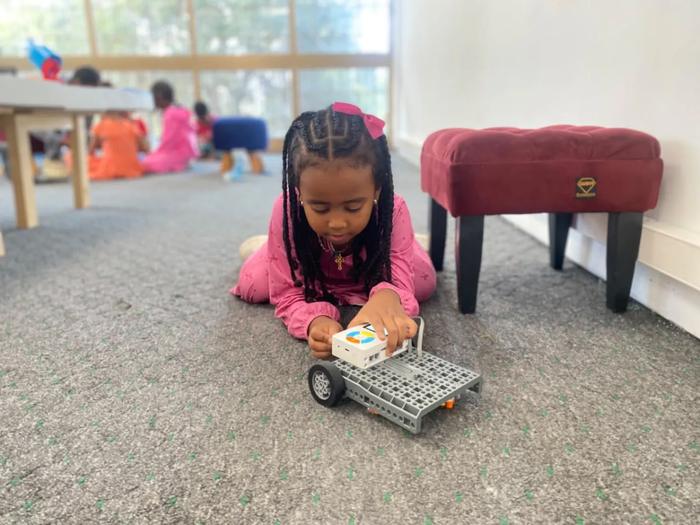
Younger children often play next to each other, not with each other. They glance over, copy a move, then go back to their own game. This is real social learning. They are studying how others play.
Playing together, with friction
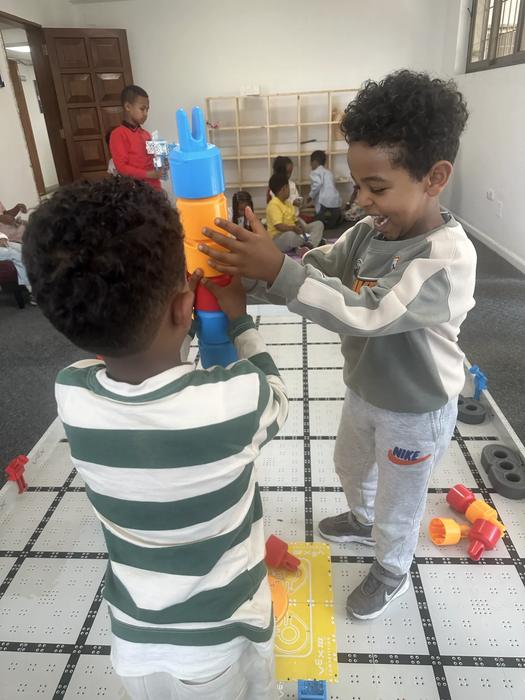
Soon children start to share a game, and the arguments begin. Who is the mother? Who is the driver? This stage is noisy and important. Children test ideas about fairness and find out that others may disagree.
Playing with plans and rules
As children grow, they invent roles, make rules and expect others to follow them. They start to see that rules keep games going longer. In KG you will often see children run a shop, a hospital or a school for half an hour.
What holistic learning means
Many school websites use the word "holistic." It can sound vague. It means the school looks after the whole child, not only the part that reads and counts.
In our curriculum we describe six growth areas:
- Thinking: curiosity and problem solving.
- Body: movement, play, dance and sports.
- Feelings: emotional intelligence.
- Values: character and respect for nature.
- Tools: multisensory materials, with some technology.
- Community: parent workshops and partnerships.
These areas connect. A child cannot share if they cannot handle frustration, and that is a feelings skill. A child cannot build a ramp with a friend without thinking, tools and teamwork all at once. A day of learning in one area spills into the others.
That is why we plan activities with more than one goal. Take a pretend market. Children count and add (thinking). They carry baskets and balance (body). They take turns as shopkeeper (feelings and values). They use scales and play money (tools). Later they invite parents to visit (community).
Why social skills matter for learning
Social skill is part of academic learning. A child who can listen to a teacher, wait for a turn and ask a friend for help can learn in a group. A child who struggles socially often struggles to settle in class, even when they are bright.
The Harvard Center on the Developing Child makes the same link. It says early relationships and emotional health form the base for language, thinking and later learning. Social skills belong to that base. They are not an extra.
What teachers do to help
They set up the room for teamwork
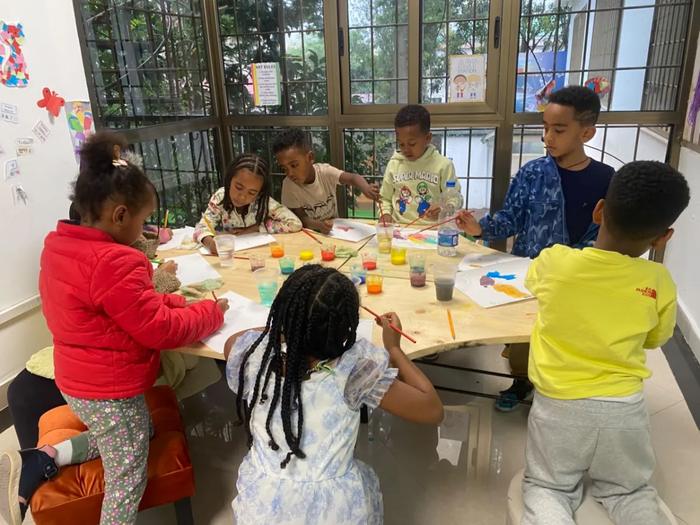
Open play areas. Enough materials for group games. Spaces where two or three children can work together. A teacher might put out one big roll of paper, so children have to paint side by side.
They coach instead of rescuing
When two children argue, the teacher helps each one say what they want. "Ali, tell Bruk what you want. Bruk, tell Ali." Then she asks, "What could we do?" Children learn that problems have answers and that they can find them.
They give words
Many social problems are word problems. A child pushes because they cannot say, "Can I play?" Teachers give short phrases: "Can I have a turn?" "Stop, I do not like that." "Do you want to play with me?" Children repeat them until they own them.
They show kindness
Children watch how adults treat each other and them. Teachers who greet each child by name, say please and thank you, and say sorry when they get something wrong teach respect through daily behaviour.
They notice the child on the edge
Quiet or new children can vanish in a busy room. Small classes let a teacher spot a child who is alone and help them into a game. That is why we keep classes small at Nucleus.
How parents can help at home
Arrange small play dates
One friend at a time is easier than a crowd. Keep the visit short, put away the most precious toys and let the children work things out with light help from you.
Practise turn-taking every day
Board games, snacks, reading time. "First I stir, then you stir." These habits carry over to school.
Talk about friends
Ask open questions: "Who did you sit next to? What made you laugh today? Was anyone sad?" Skip "Did you have fun?" The answer is usually "yes," and the talk ends there.
Do not fix every argument
If your child comes home upset about a fight, listen first. Then ask, "What could you do next time?" Children learn when they find the answer themselves, even if it is clumsy.
Welcome many kinds of play
Some children love rough games. Some love quiet drawing. Both are fine. Give your child a range of experiences and let their favourites show.
When to ask for help
Most social struggles in the early years are part of normal growth. Talk with your child's teacher if, over several weeks, your child:
- Avoids all contact with other children.
- Often hurts others and does not respond to guidance.
- Seems very upset at drop-off every day.
- Finds it hard to understand or use language to communicate.
Teachers see many children, so they can compare gently and without labels. If more support would help, a good school will talk with you about it. Children of all abilities are welcome to register at Nucleus, and we talk about each child's needs with the family, case by case.
Culture, language and friendship
Addis Ababa is a city of many languages and backgrounds. In an international classroom, children may arrive speaking Amharic, English, French, Arabic, Tigrinya or other languages at home. Learning to play with someone who speaks differently is a lesson in itself.
Our staff are professionally trained and multilingual. They help children cross language gaps and show them that differences are interesting, not scary. This is part of what we mean by global perspectives and respect for other cultures. If you are comparing schools, our sister school wrote a guide to choosing a kindergarten in Addis Ababa that pairs well with this one.
Seeing it for yourself
You can read all this and still want to see it. Come and watch a morning. See how children join groups, how teachers step in and how an argument ends. If you want your child to grow in all six areas, in a school that looks after the whole child, we would be glad to meet you.
Read more on our curriculum page, book a visit to our new campus in Bisrate Gebriel, or register now.
Related reading: Our curriculum · Register on the admissions page
Common questions
What are normal social skills for a preschool child?
Children in preschool are learning to join games, take turns, share, listen and use words to solve fights. Skills grow at different speeds. Arguments and clumsy tries are a normal part of learning.
What does holistic learning mean in a preschool?
It means teaching the whole child. At Nucleus we plan for six growth areas: thinking, body, feelings, values, tools and community. An activity usually serves more than one area at once.
My child is shy. Will they cope in a group?
Most shy children do well with time and a patient teacher. Small classes help, because a teacher can notice a quiet child and gently invite them into a game. Tell the teacher about your child's temperament when you register.
How can I help my child make friends?
Arrange short play dates with one child. Practise turn-taking at home. Give your child words for asking to join a game. Talk about their day with open questions. Let them solve small fights with light support.