On this page
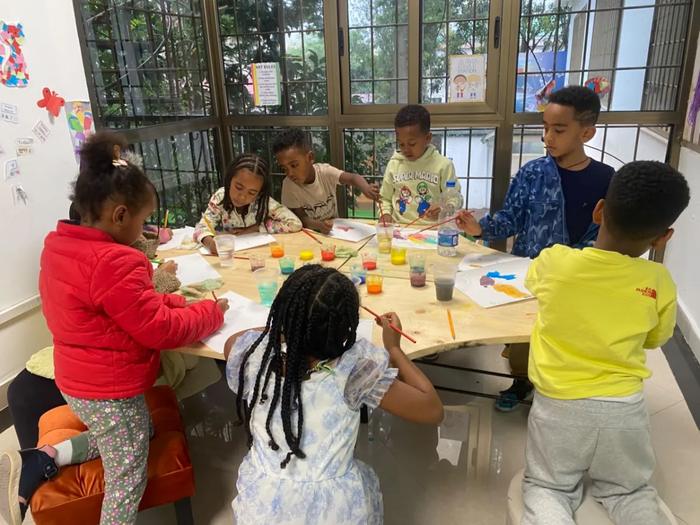
You stand at the classroom door. Six children are painting around one table. Someone spills water. Someone laughs. Where is the learning?
It is right there. In a good preschool, the play is the learning, and every part of it is planned. This guide shows what children learn in preschool, area by area, so you know what to look for.
The frame behind the play
We follow the international Cambridge curriculum for the early years, called Cambridge Early Years. It is a play-based programme written for children aged 3 to 6. Its goals cover language and early number. They also cover the world around us and personal growth.
It also keeps its areas connected. A child does not do "maths" at nine and "feelings" at ten. They do it all at once, at the same table. So when you read the six areas below, picture them overlapping.
1. Talking, listening and the first steps of reading
Language comes first. Children talk and listen. They sing, hear stories and play with rhymes. Then they notice that letters stand for sounds. Writing starts as marks and drawings and slowly becomes letters.
In our Preschool, letters and sounds come through games. In KG, children move on to early reading and writing. Ask any school how reading starts. A good answer mentions sounds and stories, not copying rows of letters.
Addis Ababa is a multilingual city. Many children hear Amharic and English at home, and some hear a third language. Our staff are multilingual, so children hear songs, stories and everyday talk in more than one language.
2. Maths: counting real things
Early maths is counting steps on the stairs and sharing snacks fairly. It is sorting buttons by colour. Children also learn words like more, fewer, before and after. Children spot patterns in beads and tiles. Most early maths happens with blocks, sand and snacks.
In Preschool, children get first numbers and number sense through play. In KG, the number work grows and so does the child's confidence with it.
3. Understanding the world
Children ask a hundred questions a day. Why is the sky grey? Where does the water go? This area turns questions into small experiments. Children plant seeds and mix paint. They feel different materials and notice the weather.
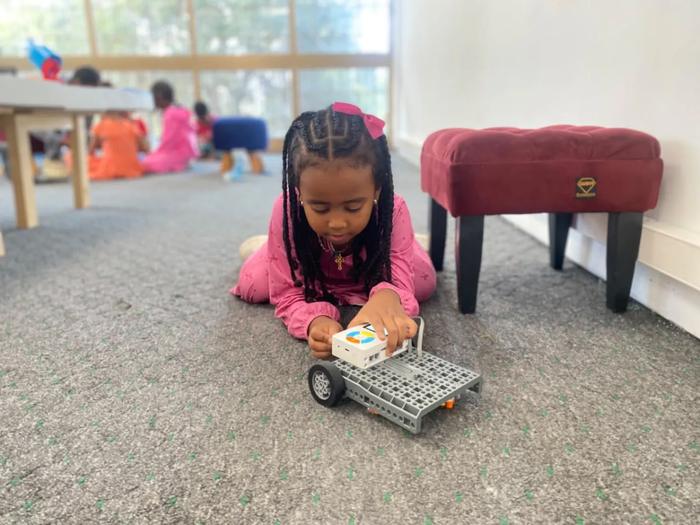
A little technology belongs here too, used with a teacher. A girl steering a small robot car across the floor is learning cause and effect. Push, roll, stop, try again.
4. Feelings and friends
Many parents say this turns out to be the most important area. Children learn to make friends and to take turns. They name a feeling and calm down after a frustration. They put on their own coat. They carry their own bag.
You will see it when a teacher kneels beside a crying child and says, "You are cross because it was your turn." That sentence is a lesson. Read our guide on emotional intelligence in early childhood to see how this grows.
5. Moving the body
Running, climbing and balancing build big muscles. Threading, cutting and painting build small ones. Those small muscles in the fingers are the ones that make holding a pencil comfortable later. The World Health Organization recommends at least 180 minutes of physical activity a day for children aged 3 and 4. That is a lot of running. Outdoor time is part of the plan, not a reward.
6. Making and imagining
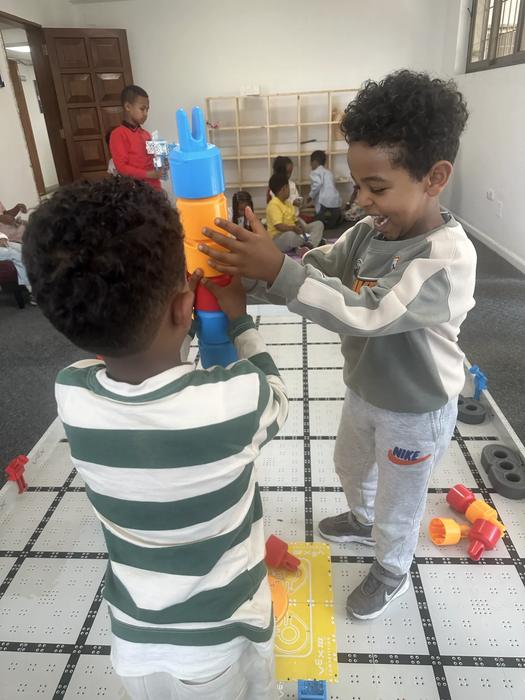
Painting and building let children test ideas about the world. So do music, dance and pretend play. A cardboard box becomes a bus one day and a boat the next. Creativity at this age is not decoration. It is how children think.
In our Preschool, children have art, music and dance every week. The photo above shows children at a shared table, passing paint pots and using brushes. It looks like play, and it is also fine motor control, colour words, sharing and patience in one activity.
How a teacher knows a child is learning
There are no exams at this age. Teachers watch and listen, and they write short notes. They notice who builds a taller tower this month, who says a new word, who now waits for a turn. Then they plan the next activity to match.
Ask any school how it keeps track of progress and how it shares that with you. A daily note, a message each week and a talk each term are all reasonable. Silence until the end of the year is not.
What you can do at home
- Talk while you cook, walk or ride. Name things. Ask questions that need more than yes or no.
- Read the same book many times. Children love it, and they learn from it.
- Let your child help: pour, stir, carry, sort the shoes.
- Give them time to get dressed alone, even if it takes ten minutes.
- Play outside every day.
What comes after preschool
The same international Cambridge curriculum pathway carries on. Children who finish our KG can continue at the Nucleus grade school at the Vatican campus, which teaches Year 2 to Year 9 (Grade 1 to Grade 8). Moving up is a step, not a leap. Our main school explains the full stage in the Cambridge Early Years curriculum, explained.
To see how our own curriculum works, come and watch a class on a visit. Our Preschool and KG are at the South African Campus in Bisrate Gebriel, next to Adot Building, Addis Ababa. When you are ready, register now or call +2519 47 50 09 92.
Related reading: Our curriculum · Play-based learning in preschool · Our programs
Common questions
What do children learn in preschool?
They learn language and early reading, early number, how the world works, how to make friends and manage feelings, how to move their bodies, and how to create. All of it comes through play, stories and hands-on materials.
Do preschoolers learn to read and write?
They take the first steps. Letters, sounds and stories come through games in Preschool. Early reading and writing grow in KG. We do not push worksheets on three-year-olds.
Is play really learning?
Yes, when it is planned. A teacher chooses materials and questions for a reason, such as counting, new words or turn-taking, and then watches what the child does.
How do preschool teachers track progress without tests?
They watch, listen and keep short notes on each child, then share them with parents. They plan the next activities from what they see.
What should my child know before starting preschool?
Nothing in particular. Children who can stay with a teacher for a morning, play near others and ask for help are usually ready. Missing one of these at age 3 is common.